Quick summary
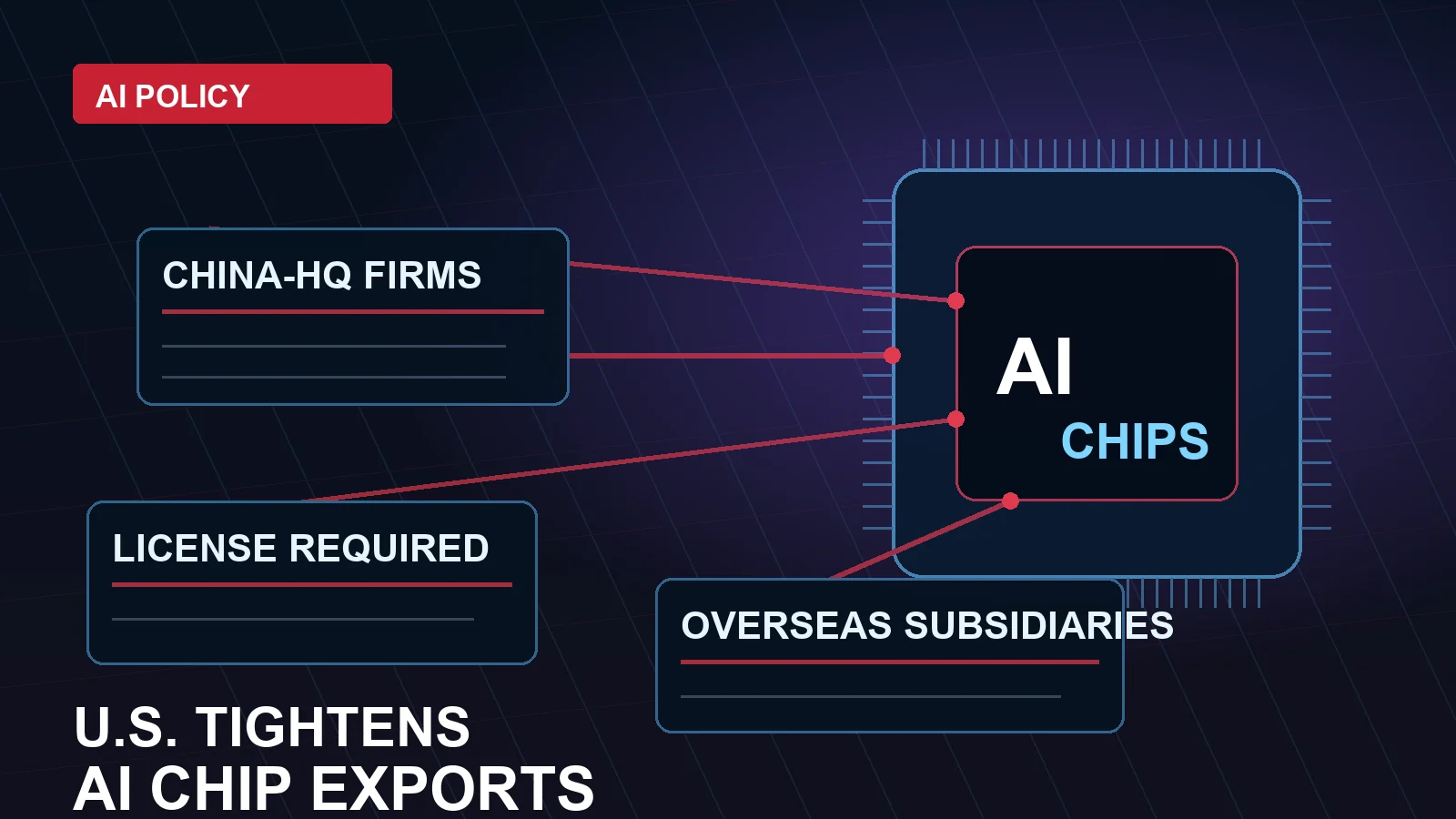
- The U.S. Bureau of Industry and Security says advanced computing exports still require a license when the buyer is headquartered in China, Macau or Country Group D:5, even if the entity is located elsewhere.
- Reuters reported that the move targets a possible route for Chinese AI firms to obtain advanced Nvidia and AMD chips through overseas subsidiaries.
- The guidance matters because AI chips are central to the U.S.-China technology contest, cloud capacity, frontier model training and national-security policy.
The United States has moved to tighten how advanced AI chip export controls apply to China-linked buyers outside China, a step aimed at closing a route that officials and analysts feared could weaken Washington's semiconductor restrictions.
In guidance dated May 31, the Commerce Department's Bureau of Industry and Security said a license is required for exports of advanced computing items to entities headquartered in Country Group D:5 or Macau, or whose ultimate parent company is headquartered there, even if the entity itself is located outside those destinations.
Reuters reported that the weekend guidance targets a potential loophole under which subsidiaries of Chinese companies in places such as Malaysia could seek access to advanced processors, including Nvidia's high-end AI chips, despite broader U.S. efforts to limit China's access to leading semiconductors.
What changed
The guidance does not read like a brand-new export-control regime. It is framed as a clarification that earlier license requirements continue to be enforced, including for advanced computing items tied to companies headquartered in China-linked destinations.
That distinction matters. It means the compliance question is not only where a subsidiary is physically located, but who ultimately controls it and where the parent company is headquartered.
Why it matters
Advanced AI chips are no longer treated as ordinary commercial components. They sit at the center of the global AI race, military technology concerns, cloud-infrastructure strategy and the broader U.S.-China competition over compute power.
Who is affected
The immediate focus is on companies that sell, ship or service advanced computing items and the buyers trying to access them through overseas structures. Reuters reported that an Nvidia official said the guidance does not change the company's position because Commerce had already clearly imposed license requirements on Nvidia through a letter.
AMD was also named in the Reuters report as another major supplier of sought-after AI chips. The policy context also touches foundries, distributors, data-center operators and compliance teams that must screen customer ownership and parent-company links.
What remains unclear
The scale of any past shipments through the route is not settled publicly. Reuters cited one chip-industry source estimating large volumes, but the exact number remains unclear. BIS also said bona fide data-center operators are not required to stop ongoing use, storage, disposal or servicing of advanced computing items because of this guidance until further notice.
What happens next
Watch for company compliance updates, Chinese government reaction, and whether Washington follows with rules covering cloud access, foundry due diligence or overseas data-center use. The next phase of AI export controls may be less about a chip's destination and more about who ultimately controls the buyer.
Sources and references
- Bureau of Industry and Security: Guidance on advanced computing items, May 31, 2026
- Reuters via MarketScreener: U.S. takes step to halt Nvidia AI chip shipments to Chinese firms outside China
- Al Jazeera: U.S. says ban on AI chip shipments applies to Chinese firms outside China
What happens next
The practical test is enforcement: whether exporters deny more transactions, whether license applications rise, and whether Chinese AI companies shift toward domestic chips, cloud workarounds or alternative supply chains.