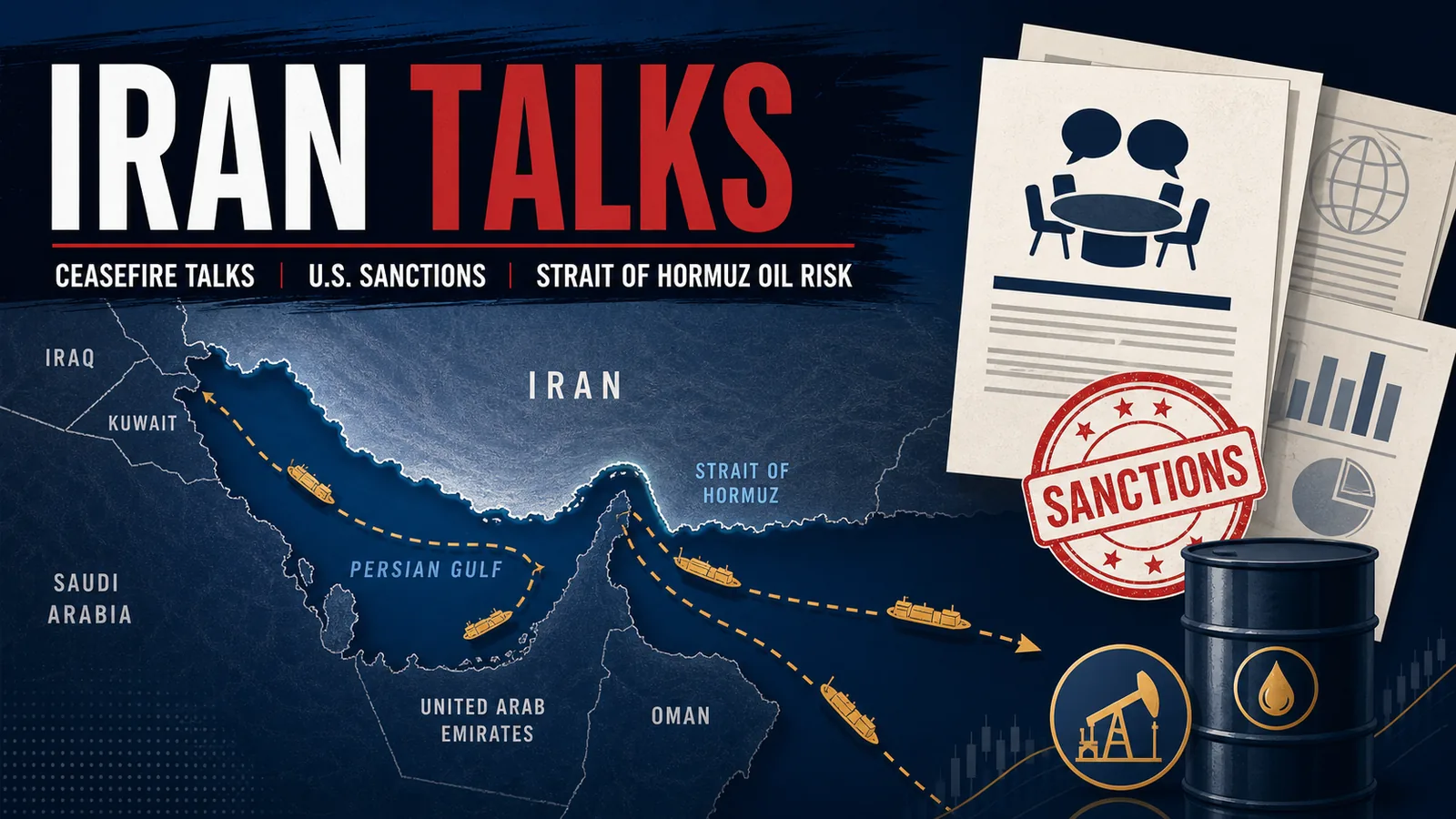
Quick summary
- AP reported that U.S. and Iranian negotiators have reached a tentative framework to extend the ceasefire and begin nuclear talks, pending approval from President Donald Trump.
- The U.S. Treasury announced fresh sanctions on Iranian military oil sales, keeping economic pressure on Tehran even as diplomacy continues.
- The Strait of Hormuz remains central because it is the world's largest oil-transit chokepoint by volume, according to the U.S. Energy Information Administration.
U.S.-Iran diplomacy is moving into a narrow test phase: negotiators have reportedly worked out a tentative framework to extend the ceasefire and begin nuclear talks, but Washington is still tightening pressure on Iran's oil revenue.
The Associated Press reported that U.S. and Iranian negotiators reached a tentative agreement to extend the ceasefire by 60 days and launch talks on Iran's nuclear program. The report said the emerging memorandum still needs President Donald Trump's approval.
That means the development is important but not final. It signals that both sides may still see room for a political track, while leaving the outcome dependent on the White House and on unresolved questions around Iran's uranium stockpile and enrichment.
Why sanctions still matter
The diplomacy is unfolding at the same time as a new sanctions push. The U.S. Treasury said on May 28 that it was taking additional action against Iranian military oil sales, saying the revenue helps fund the rebuilding of Iran's armed forces.
That combination is the key tension in the story. A ceasefire extension would lower immediate military risk, but sanctions are meant to keep financial pressure high until Washington sees changes it considers durable.
The previous day, Treasury also announced sanctions against Iran's so-called Persian Gulf Strait Authority, describing it as an IRGC-linked attempt to extract value from commercial shipping through the Strait of Hormuz.
Why the Strait of Hormuz is still the pressure point
Hormuz is not just a regional waterway. The U.S. Energy Information Administration describes it as the world's most important oil-transit chokepoint by volume. Its recent chokepoint data estimated 23.2 million barrels per day of oil flow through Hormuz in the first half of 2025.
That is why even a diplomatic opening can move alongside market anxiety. If shipping rules, sanctions risk, or military incidents affect Hormuz, the consequences can reach fuel markets far beyond the Gulf.
The Oman angle
The Oman part of the story is sensitive because Muscat has long been a U.S. partner and a quiet mediator in Gulf diplomacy. Several outlets reported that Trump appeared to threaten Oman after being asked about a short-term arrangement involving Iran, Oman and Strait of Hormuz access.
The clean way to read it is not as a confirmed attack plan. It is a warning sign about how quickly the Hormuz dispute can pull even U.S.-aligned Gulf states into the pressure campaign, especially if Washington believes a tolling or control arrangement would benefit Iran.
Video context
Firstpost's Vantage segment discusses the Trump-Oman remarks and the Strait of Hormuz dispute. The video is used here as a topic lead; the article's factual framing is cross-checked with written source links below.
Hindi video explainer
Ankit Avasthi's Hindi explainer gives additional background on the Oman toll question and why the Strait of Hormuz matters. It is included as reader context, while the article keeps its main facts tied to written sources.
Why it matters
The story matters because it combines three pressure points: a possible diplomatic opening, unresolved nuclear questions, and a sanctions campaign aimed at Iran's oil revenue. If any one of those breaks down, the ceasefire and energy-market risk could shift quickly.
What happens next
The next signal is whether Trump signs off on the reported framework. After that, watch whether the ceasefire holds, whether nuclear talks get a clear venue and timeline, and whether Treasury expands sanctions enforcement against shipping, oil buyers or financial channels.
For now, the safest reading is cautious: diplomacy has not disappeared, but it has not replaced pressure.
Sources and references
- Associated Press: U.S. and Iranian negotiators reach tentative ceasefire and nuclear-talks deal
- U.S. Treasury: Economic Fury targets illicit oil revenue fueling Iran's military
- U.S. Treasury: Economic Fury targets Iranian maritime extortion
- U.S. EIA: World oil transit chokepoints
- The Guardian: Trump-Oman remarks and Strait of Hormuz talks
- Firstpost Vantage: Video discussion on Trump, Oman and Gulf pressure
- Ankit Avasthi: Hindi explainer on Oman, Iran and Strait of Hormuz toll questions
What happens next
Key things to watch: Trump approval, the first nuclear-talks timetable, any ceasefire violations, and whether Hormuz-linked sanctions warnings affect shipping or oil-market pricing.