Quick summary
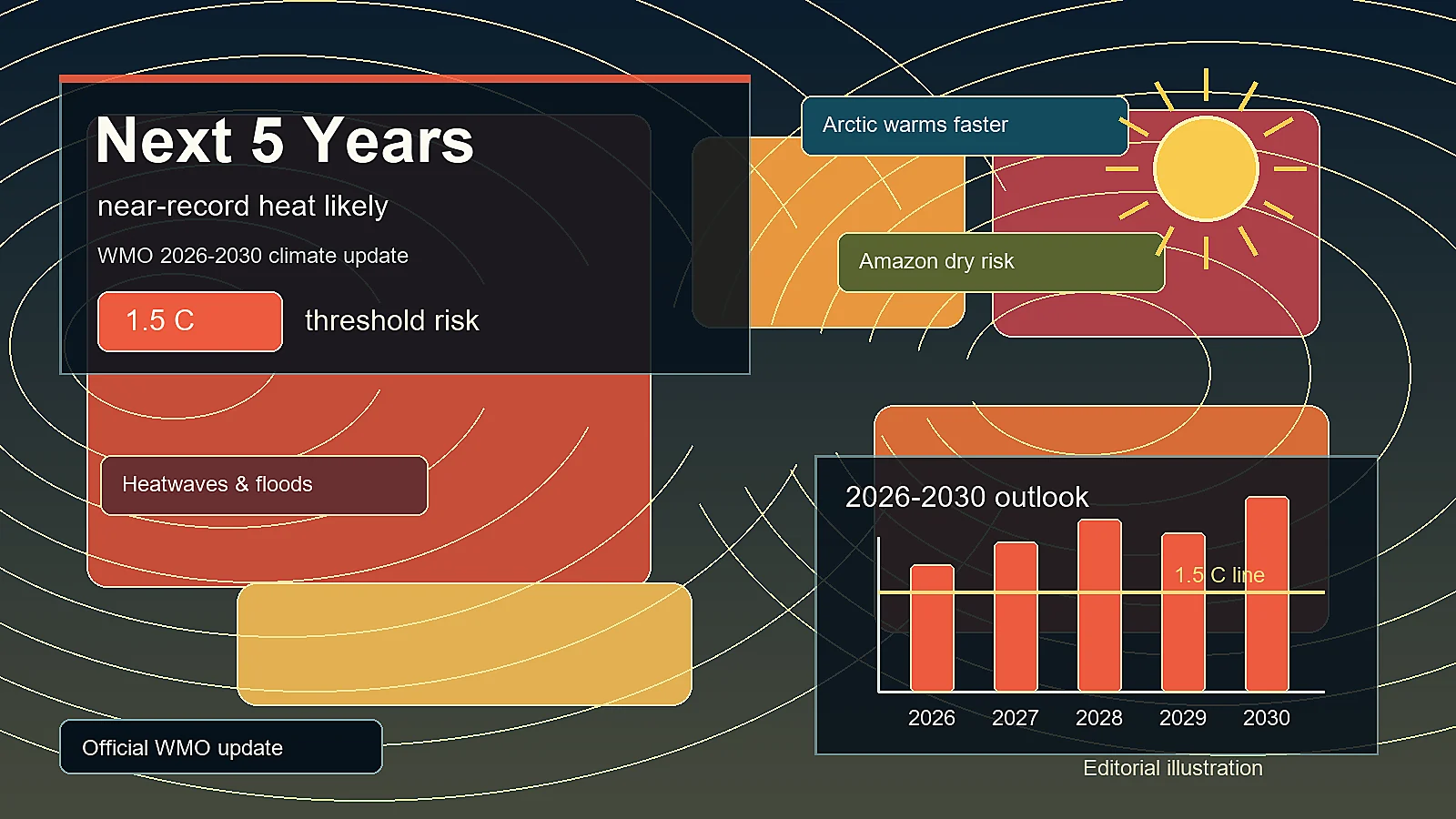
- The World Meteorological Organization says at least one of the next five years is likely to be the warmest on record.
- The outlook says the world remains at risk of temporarily exceeding the 1.5 C warming threshold in individual years.
- The forecast highlights regional risks including faster Arctic warming, heatwaves, heavy rainfall and Amazon drying concerns.
The World Meteorological Organization's latest five-year climate outlook says the planet is still moving through a dangerous heat phase, with a strong chance that at least one year between 2026 and 2030 will become the warmest on record.
The UN agency's Global Annual to Decadal Climate Update says global temperatures are expected to remain near record levels. The report also warns that individual years may temporarily move above the 1.5 C threshold used in global climate policy.
That does not mean the Paris Agreement threshold has been permanently breached. The 1.5 C goal is judged over longer-term averages, not one hot year. But repeated temporary exceedances are a warning sign that the climate system is staying close to a line governments have pledged to avoid.
What the WMO is warning about
The WMO outlook is not a single-day weather forecast. It is a climate risk forecast for the next several years, based on modelling from major climate centres. It looks at likely temperature patterns, rainfall shifts and regional extremes.
The agency says Arctic warming is expected to remain faster than the global average. It also flags the possibility of regional rainfall changes, including risks for areas already vulnerable to flooding, heat stress or drought.
For readers, the practical meaning is simple: climate risk is not only about distant future decades. It is already shaping the next few years of heat, food security, public health and disaster planning.
Why it matters
Record heat has knock-on effects. It can raise electricity demand, stress water systems, worsen wildfire risk and make outdoor work more dangerous. It can also increase the chance of extreme rainfall because a warmer atmosphere can hold more moisture.
The Amazon and Arctic signals are especially important because they affect global climate feedbacks. Faster Arctic warming can reshape ice, weather patterns and ecosystems, while Amazon drying risk is watched closely because the rainforest stores vast amounts of carbon.
Audience language score
Internal publishing score: English 78%, Spanish 12%, French 8%, Hindi 6%, Arabic 4%, Bengali 3%, Russian 3%, Urdu 2%. English remains the only published version because the topic is global, the main source is in English, and no non-English audience score crosses the translation threshold.
What happens next
The next signals to watch are national temperature records, updated El Nino or La Nina conditions, and whether governments adjust heat-action, flood-control or crop-planning systems before the next high-risk season.
Sources and references
- WMO: Global Annual to Decadal Climate Update 2026-2030
- WMO publication series: Global Annual to Decadal Climate Update
- United Nations: Paris Agreement overview
Why it matters
The forecast points to near-term climate risk, not a distant problem. Heat, rainfall extremes and regional warming patterns can affect health, crops, power systems and disaster planning within the next few years.
What happens next
Watch for updated national heat plans, seasonal forecasts, and whether another record-hot year arrives before 2030.