Quick summary
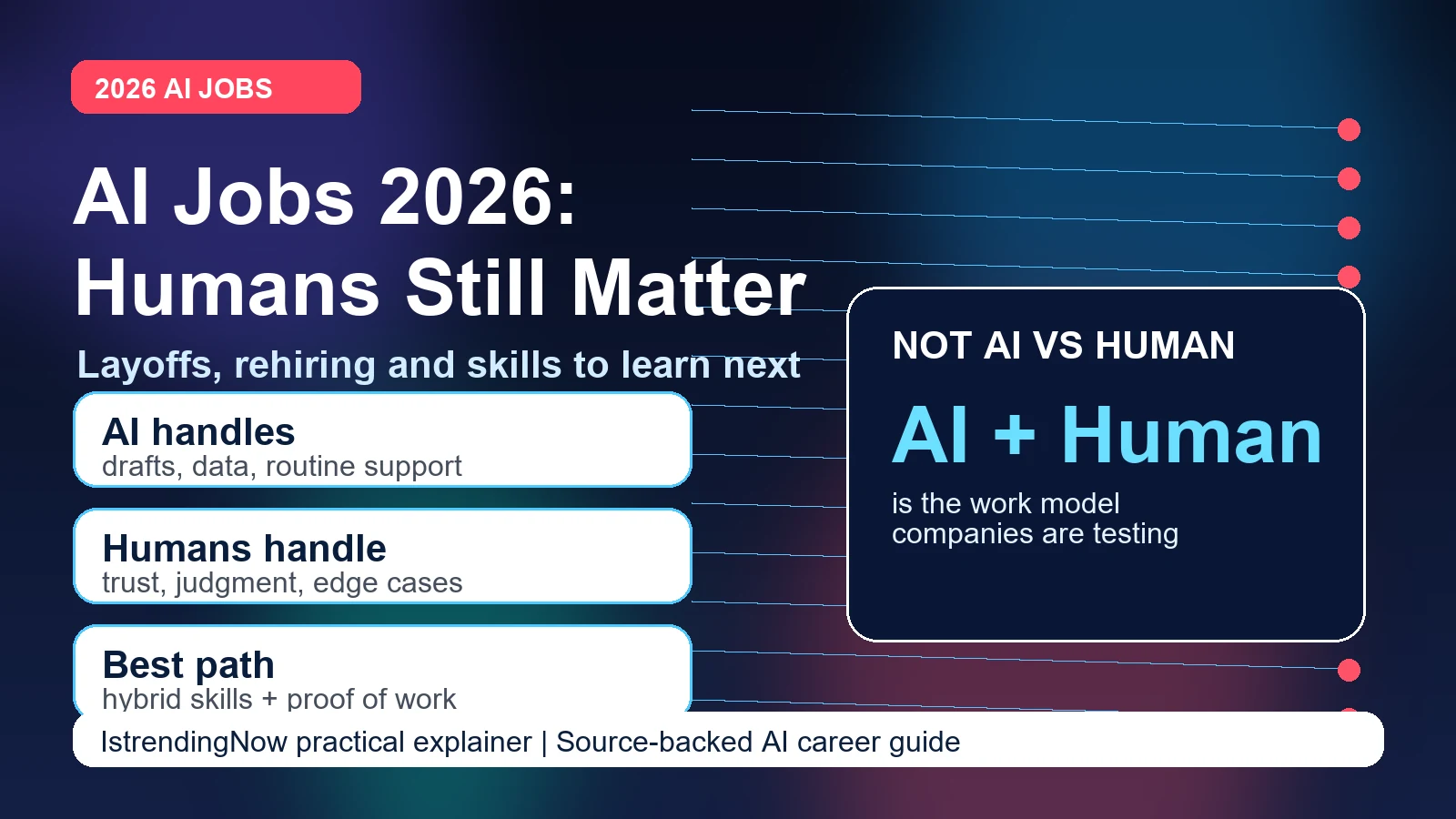
- AI is pressuring jobs, especially routine digital work, but the strongest pattern is hybrid work rather than simple full replacement.
- Companies still need humans for trust, escalation, domain judgment, customer emotion, compliance and messy edge cases.
- The best 2026 career strategy is not “avoid AI”; it is to pair AI tools with a real domain skill and visible proof of work.
Drafting, summarising, classifying, coding assistance, support triage and repeatable workflows.
Judgment, accountability, relationship handling, legal risk, taste, empathy and final decisions.
Learn AI-assisted work inside a useful domain: finance, design, sales, operations, security, law or support.
Video context
The StudyIQ IAS video below raises the same question many workers are asking: is the AI bubble bursting, or are companies simply learning where humans still belong?
AI jobs are not moving in a clean straight line. Some companies are cutting roles and using AI as part of the explanation. Some are spending heavily on AI infrastructure. Some are discovering that automation without enough human backup can damage quality, trust and customer experience.
That makes the “AI bubble” question too simple. A bubble can exist in valuations or spending expectations while the technology itself remains useful. Workers need a practical reading: what tasks are getting cheaper, what work still needs people, and how to become the person who works well with AI instead of being replaced by a basic workflow.
The short verdict
AI is replacing some tasks, not every worker. The risky jobs are roles built mostly on repeatable digital output. The stronger jobs combine AI speed with human responsibility, customer trust, domain expertise or real-world execution.
Why companies are still hiring humans
AI systems can answer common questions quickly, but many businesses still need humans for angry customers, sensitive cases, legal exceptions, unusual orders, high-value sales and decisions that create reputational risk.
The Klarna story became a warning sign for this reason. After aggressively using AI in customer service, the company later discussed bringing humans back into parts of the experience so customers could still reach a person when needed. The lesson is not that AI failed; it is that companies need escalation paths.
Where AI pressure is strongest
- Basic content production: simple rewrites, generic summaries, low-context product descriptions and routine social posts.
- Entry-level digital operations: formatting, tagging, ticket triage, spreadsheet cleanup and basic internal reporting.
- Customer support first response: common questions, order status, refunds, password resets and scripted troubleshooting.
- Simple coding tasks: boilerplate, tests, documentation drafts and predictable app changes.
Where humans are harder to replace
Humans are harder to replace when work involves accountability, taste, negotiation, physical context, legal judgment, emotional intelligence or multiple messy constraints. A support agent handling a furious customer, a nurse making a practical call, a salesperson reading a room, or an operations manager fixing a broken process is doing more than typing.
The World Economic Forum's Future of Jobs work points to a labour market where technology changes skills and task design through 2030, not a simple disappearance of work. The IMF has also warned that AI can affect a large share of global employment, especially in advanced economies, while increasing inequality if workers and institutions do not adapt.
Skills that can age well in 2026
- AI tool use plus domain knowledge: use AI inside accounting, HR, logistics, sales, law, design, support, health admin or education.
- Verification skills: check sources, test outputs, spot hallucinations and keep audit trails.
- Customer judgment: handle escalation, emotion, edge cases and trust-sensitive conversations.
- Workflow design: connect tools, document processes, build templates and measure what improves.
- Security awareness: understand data privacy, phishing, account protection and safe AI use.
A practical 30-day learning plan
- Pick one real domain you already understand: sales, office admin, design, finance, coding, support, teaching or operations.
- Choose two AI tools and learn them deeply enough to finish real tasks, not just prompts.
- Create three proof-of-work examples: a report, a workflow, a dashboard, a customer-response system or a mini app.
- Write down where AI helped, where it failed and how you verified the output.
- Turn that into a portfolio page, LinkedIn post or resume project with before-and-after results.
FAQ
Is the AI bubble bursting? Some AI spending may be overhyped, but the technology is still useful. The more realistic view is a shift from hype to ROI pressure.
Will AI replace entry-level jobs? Some entry-level tasks are at risk. That makes proof-of-work, tool fluency and domain context more important for beginners.
Should workers avoid AI-heavy fields? No. Avoiding AI is risky. A better path is learning how to use AI responsibly inside a valuable field.
Sources and references
- StudyIQ IAS: Is the AI Bubble Finally Bursting?
- World Economic Forum: Future of Jobs Report 2025
- International Monetary Fund: Artificial Intelligence topic page
- TechCrunch: Klarna CEO says company will use humans for customer service
- CNBC: Klarna CEO discusses AI and workforce changes
- AP: Meta layoffs and AI infrastructure spending context