Quick summary
- The European Commission says the AI Act becomes fully applicable on August 2, 2026, with some exceptions.
- Article 50 transparency rules mean people may need to be told when they interact with AI or see certain AI-generated/manipulated content.
- GPAI model providers face Commission enforcement powers from August 2, 2026.
The EU AI Act is moving from “future regulation” into a practical checklist. For many businesses, the hard part is not reading the whole regulation. The hard part is knowing which AI systems they use, whether users need disclosure, whether a vendor is responsible for model obligations, and whether any use case may be high-risk.
The European Commission’s AI Act page says the regulation entered into force in 2024 and will be fully applicable on August 2, 2026, with some exceptions. The Commission also says transparency rules come into effect in August 2026.
Deadline map
| Date | What to watch | Who should care |
|---|---|---|
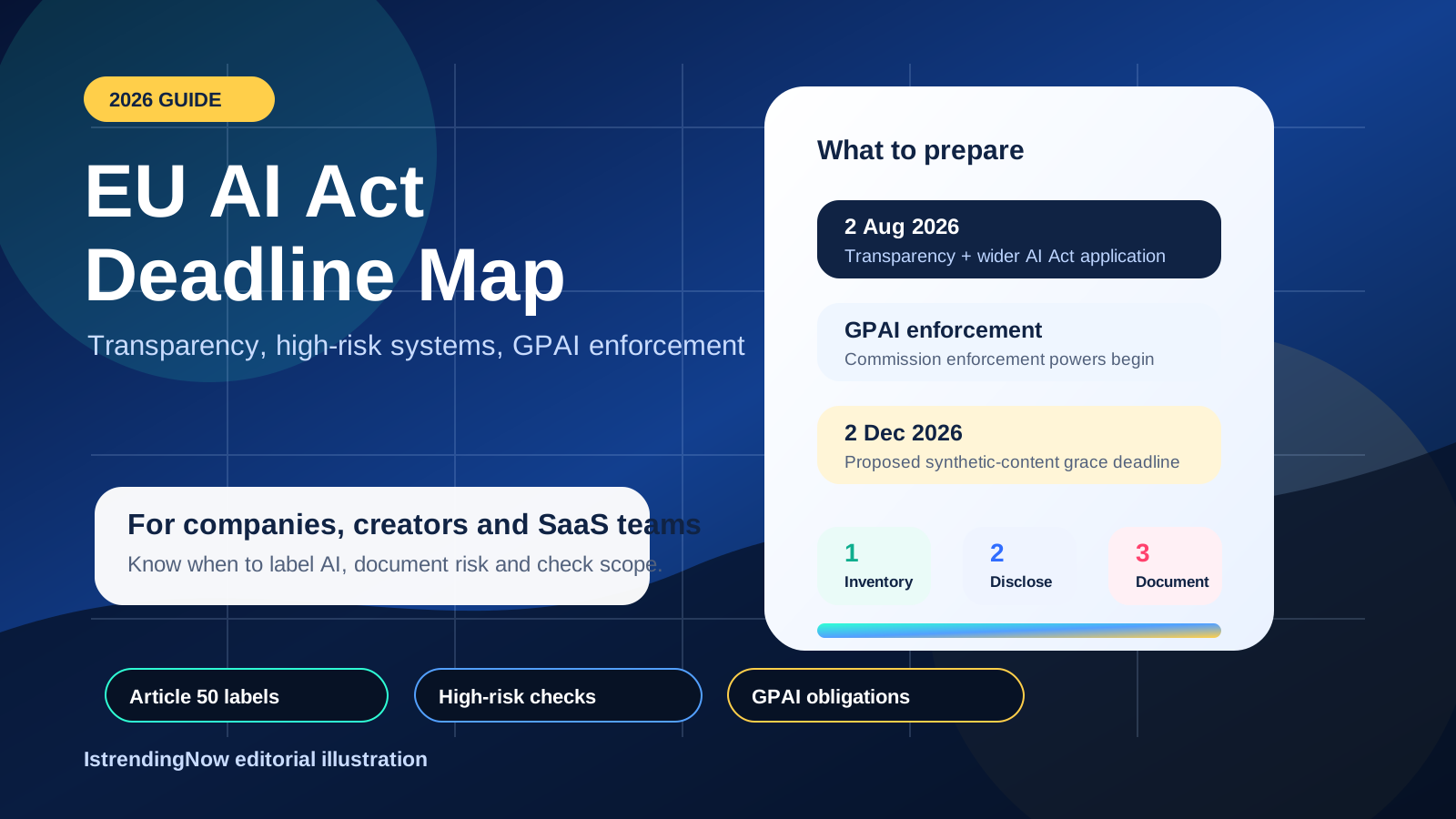
| August 2, 2026 | Article 50 transparency obligations and wider AI Act application | Businesses, creators, SaaS teams, AI deployers |
| August 2, 2026 | Commission enforcement powers for GPAI provider obligations | AI model providers and companies buying model access |
| December 2, 2026 | Proposed shorter grace deadline for synthetic-content transparency solutions under the simplification agreement | Providers of systems that generate or manipulate content |
| August 2, 2027 | Proposed deadline for national AI regulatory sandboxes | Startups, regulators and test environments |
What Article 50 means in plain English
Article 50 is about transparency. The Commission says people in the EU will have to be informed when they are interacting with AI systems or exposed to certain AI-generated or manipulated content. For providers, this can include making AI-generated or manipulated content detectable through machine-readable marking.
The simple rule
If AI is speaking to a user, making content look real, or generating/manipulating media, do not hide that fact. Start designing disclosure and labeling flows now.
What businesses should do now
- Inventory AI use: list chatbots, internal copilots, content generators, scoring tools and customer-facing AI features.
- Classify risk: check if any system touches employment, education, essential services, biometric uses, law enforcement, migration, justice or other sensitive areas.
- Plan transparency: decide where users must see AI disclosures or content labels.
- Check vendors: ask AI providers what documentation, GPAI obligations, model summaries and copyright-compliance support they provide.
- Keep records: save prompts, policies, training notes, risk decisions and vendor responses.
What creators and publishers should watch
Creators should watch the transparency guidance closely. If a site, agency or social page publishes AI-generated or manipulated content in a way that can mislead readers, the safe direction is clear labeling, editorial review and not presenting synthetic media as real evidence.
This matters for news, marketing, product images, explainers, ads and political content. The rule is not “never use AI.” The rule is closer to: if AI materially changes how a person understands what they are seeing, explain it clearly.
What happens next
The next months are about guidance and operational detail. Watch for final transparency guidance, the legal adoption/publication process for the simplification changes, and more practical material from the AI Office and AI Act Service Desk.
Fast checklist
- Do we use AI where EU users see output?
- Do users know when they are interacting with AI?
- Do we create AI images, audio, video or text that needs labeling?
- Do we know whether our AI vendor is a GPAI provider?
- Have we documented why each system is low-risk, limited-risk or potentially high-risk?